On the 3rdSeptember, four mrmbers of SCCS went to the 2 day Jan Beaney workshop at Bobby Britnell's.

We stayed at a lovley B&B (http://www.lloyneymillbandb.co.uk/), and had 2 great days of stitching.




 2021
2021 2022
2022
 View of the kitchen garden from my attic bedroom window.
 As an 'ice-breaker' on the first night we swapped ATC's.


 Graduation of tone using cross stitch and only black and white threads of varying thicknesses.
 A simple design showing how lines and detail can be added to make the pattern appear darker.
 Pattern development to create darker/lighter tone. Worked from pattern created on graph paper in previous exercise.
 Spacing between stitches used to control the tone. The first few rows are overlapped.
 Different thicknesses of threads used to create darker/lighter tone.
 This is an example of blackwork that I created in a previous course, showing a combination of methods to control tone.
 Sutton Coldfield Creative Stitchers were very fortunate on Saturday to have a visit from Amanda Clayton. Her workshop was called CELEBRATION OF CLOTH IN A NEUTRAL PALETTE. We were not sure what to expect, as the list of materials needed was a little bizarre and included rice, pebbles, herbs and glass!
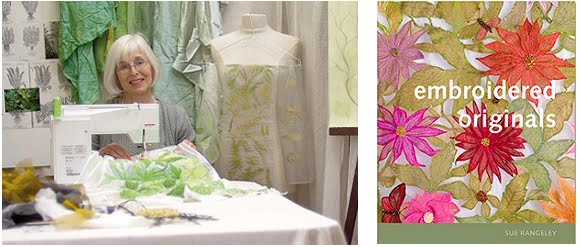 Oh, dear! Bought another book on Saturday! I went to Wolverhampton EG with a couple of friends, to a lecture by Sue Rangeley. What an amazing lady! Her machine embroidered lace panels inspired by her sketches of frosty plants were exquisite, and her silk organza skirts, jackets and bodices, appliqued with flowers made me eager to get home and try out some of her techniques! Alas, I have my priorities, so that will have to wait for another day (perhaps a workshop next year......?)
 from the top:
 ink from stamp pad applied with simple 'circles' stamp
 felt tipped pen
 ink / marker pen / charcoal / pencil on white paper
