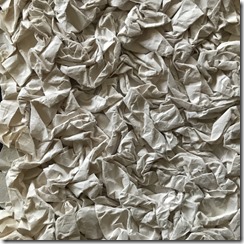
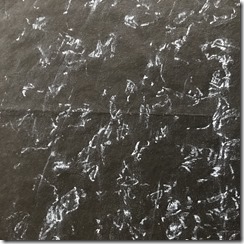
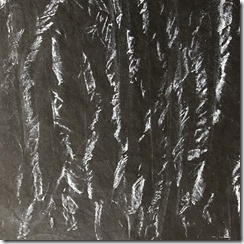
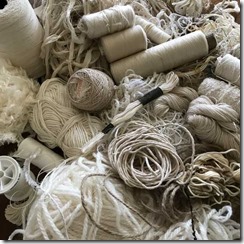
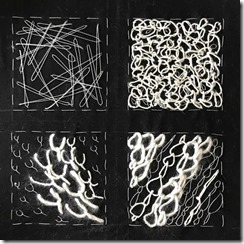
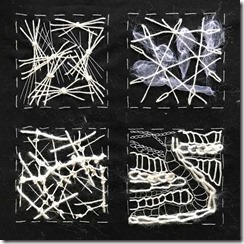
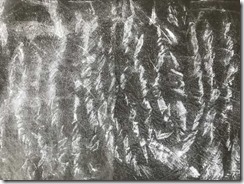
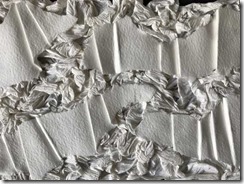
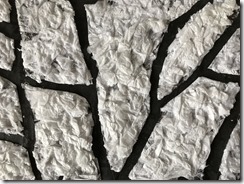
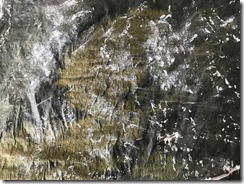
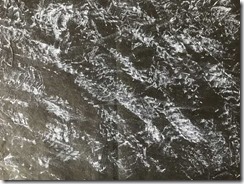
Paper relief surfaces from Chapter 3 have been translated into tactile contrasts in fabric. Each paper sample has been reproduced in two different ways in fabric.
 |
| 050801 |
Pipe cleaners were laid under nylon tulle netting and overcast with machine zig zag stitch. The pipe cleaners were then bent into irregular shapes to mirror the twisted paper.
I love the way you can bend and control the direction of the pipe cleaners, and the puckered effect this creates in the netting between the pipe cleaners.
I like the way you can create a length of texture that appears almost transparent due to the 'see through' nature of the netting.
I think it would have been better if the zig zag stitching was heavier/bolder and so more noticeable, therefore disguising the pipe cleaners.
 |
| 050802 |
Knotted
strips of frayed scrim, of varying thicknesses. Knots spaced randomly. Some
close together, some further apart. These strips were then couched down onto
the background fabric.
The knots
appear to give a slight change of direction in the lengths of scrim. I love the
raggedy, knotty, irregular texture. Stringy, linear and bumpy.
 |
| 050803 |
Threads were
pulled in lengths of scrim, both horizontally and vertically creating a rough,
randomly crinkled, ripply effect. The loose horizontal threads were twisted
together in groups to form the sinewy ladder effect between the more solid
strips of texture.
Its
interesting to see how the original photograph of strong, solid, vertical tree
trunks has evolved through the various translation processes into quire a soft,
fluffy texture!
 |
| 050804 |
A small piece of Kozo fibre was soaked overnight, then teased & stretched gently to form a sinewy visual texture. The resulting piece if fibre ended up more than four times bigger than the original piece, before soaking.
I wanted to build this sample up further using stitch, but felt that would then be overworked, as the criss-crossing threadlike, fibrous, stringy texture emulated the paper sample perfectly, without any further work.
 |
| 050805 |
Cotton
velvet was hand stitched both horizontally and vertically at random intervals,
and gathered in both directions to form a crumpled, wrinkled texture. This was
held down with massed patches of cross stitches giving the occasional deeper
shadow effect.
It's
interesting how, in viewing some of these samples on screen, they appear
different, and somehow, more interesting. I really didn't like this sample, but
when viewing it differently, I think it replicates the paper sample very well.
I also find the contradiction between the rough crinkly visual texture, and the
bumpy, but soft tactile handle of the velvet, very interesting.
 |
| 050806 |
Pieces of poly-cotton, scrim, and nylon netting were knotted in the middle, then fanned out to form bow like shapes. These were haphazardly arranged, and held down in the middle by a tiny stitch into the background fabric.
There is interesting contrasts between the soft, fluffy poly-cotton knots, the loose, raggedy quality of the scrim, and the springy texture of the tulle.
Upon reflection, I think I should have varied the sizes of the knots. Some big and chunky, some loose, others small and tight. This would have created a deeper contrasting tactile texture.
 |
| 050807 |
This is
another sample that looks more interesting when viewed differently.
Tyvek was
ironed gently on both sides to shrink and crumple.
Tucks were
machine stitched into poly-cotton fabric with a wing needle and zig zag stitch
to create interest. These were pressed flat to replicate the folded paper. This
was cut into shapes and stitched to the Tyvek.
The
poly-cotton has been stained with coffee, as the original samples did not give
enough visual contrast. I should have photographed this first, as I now feel
they are far too dark. I might go back into the sample and dry brush the
poly-cotton with a 'magnolia' emulsion.
The burned
Tyvek has a very hard , crumpled texture, whereas the poly-cotton is very
smooth and soft. However, despite these contrasts, I find the resulting sample
very flat and disappointing.
 |
| 050808 |
I took a
long time to ponder over this sample and am really excited by the results.
I had
decided upon using nylon lycra to stretch over foam board as a padded quilting
method, stitching closely through the lycra around the edges of the foam board.
The impression of the folded paper was recreated using a few long stitches of
thin machine thread over the foam board shapes.
Deciding
upon the texture between the shapes was more of a struggle. I was originally
going to use a fabric gathered in both directions, but I had used this in
sample 050805. I considered tying knots around little stones, as this was my
favourite texture from chapter 7. But that was not stretching my imagination
enough! After a lot of thought, I decided to tear thin strips of silky
polyester dress lining fabric, and knit a length of fabric. This was then
stitched down around the edges of the foam board, and, whilst holding my breath
until I turned blue, I cut the knitted fabric around the edges of the foam
board. I imagined that all of the knitting would unravel itself & ladder,
but thankfully, I think I used enough tight tiny stitches around the edges to
stop this.
I'm so
pleased with the way the knobbly knitting cotrasts so beautifully with the
lovely smooth raised feel of the lycra covered foam board.
 |
| 050809 |
The centre lines of the sample were straight tucks, stuffed with pipe cleaners in order to control the directing of the resulting ridges. However, I was not sure if the firm, crisp nature of the cotton organdie use in this sample would lend itself to being stitched into circular tucks. The fabric seemed to have a mind of its own, and it was a very tricky process, but the results were rewarding. The organdie has created very sharp edges around the circular tucks. The centre of the circles is held nice and tight, whilst the outside of the circles, an interesting undulating, ripple effect has formed.
I also like the contrasting depth of opacity where the layers of the translucent organdie have been doubled.
 |
| 050810 |
A length of knitted nylon lycra was cut on the bias (does knitted fabric have a bias?) , hand stitched, and gathered in a smocking formation. I think that by gathering on the 'cross' of the fabric, the gathers have not formed as neat regular rows, but have wobbled and collapsed in places. This is exactly the effect I wanted.
Another piece of nylon lycra was machine stitched in circles to a strong calico backing, and then stuffed from behind.
The strip of smocking was then attached with hand stitching between the 2 blocks of firm bobbly circular shapes.
I love the way the very contrasting textures of the stuffed spheres and the smocked ridges have both been created from the same fabric.